The actual tasks are licensed.
The root constructs the Klein–Gordon standing source and canonical licensed metric/scalar presentations, with proved receiver maps and their stated coverage.
The gravity-quantum arc / Amos Jay Maley
From Kernel governance to two connected dynamics endpoints.
Follow a connected construction from the AASC Kernel and AMetric discipline through canonical metric licensing to Einstein-form first-response and free-scalar Schrödinger dynamics. Proved receiver maps, shared original preparations and evolution compatibility bring the branches together in a machine-checked cross-corpus capstone.
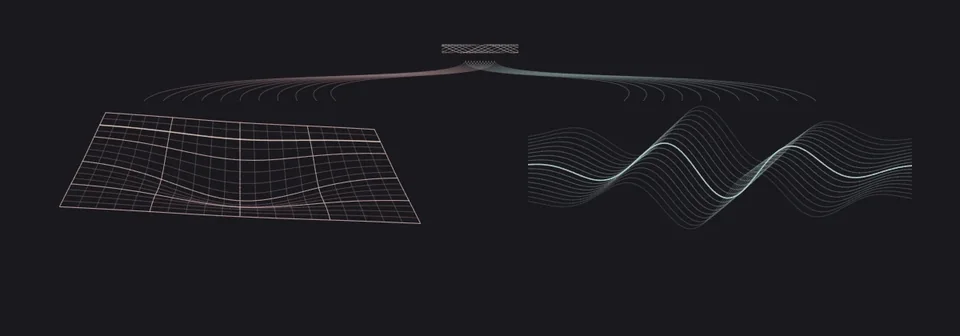
A common Kernel-governed source
01 / Kernel necessity and AMetric governance
A ruler assumes that we can keep track of what is being measured. An equation assumes that its symbols still refer to the same things after a calculation. AASC begins with the requirements that make such determinate use possible.
The Kernel establishes necessary roles for identity-preserving, non-degenerate construction: admissibility, standing, reference and irreversibility. The capstone instantiates those roles on actual physical use tasks and carries their governance into both dynamics branches.
The AMetric restriction comes before metric authority. A distance, rank, probability or hidden selector cannot simply be assumed to decide what counts as an admissible construction. Later descriptions must earn authority for their declared use.
The KernelThe AMetric BoundaryThe fixed-domain uniqueness result
The necessity claim concerns fixed-domain, identity-preserving, non-degenerate construction. Its roles govern the later constructions; they do not alone choose a spacetime dimension, a physical action, a numerical mass or a Hamiltonian. Those are explicit data in the downstream physical constructors.
Here, emergence means structural dependency and derivation within those declared constructions. The order of this tour is an explanatory path through a branching proof, not a temporal creation story or a claim that every manuscript in the corpus has been formalized.
02 / Canonical L-metric licensing
A useful description can change how a physical task is presented while retaining its original meaning. Canonical L-metric licensing establishes the safe uses for which the required answers, records and continuations survive that change.
The composed proof builds the actual canonical Kernel/AMetric/licensing assembly for the declared metric and scalar tasks. It proves licensed receiver presentations and their stated coverage, then connects those receivers to the downstream dynamics.
A receiver is the constructed presentation through which the original task can be read faithfully. Licensing establishes that faithfulness; the Kernel-faithful physical constructors supply the source, carriers, action and analytic hypotheses that the receiver needs.
Metricity as Licensed DescriptionThe canonical licensing adapter
The theorem retains Kernel roles, AMetric discipline, five licensing conclusions and nonempty safe regions on the stated tasks. The downstream construction fixes positive mass, speed and ℏ, four spacetime and three spatial coordinates, continuum carriers, a Klein–Gordon/free branch and the original Einstein–Hilbert relative action. Licensing does not manufacture these choices or select a preferred physical projection.
03 / Einstein-form first-response dynamics
The metric branch constructs a bounded Einstein–Hilbert receiver. Its maps retain the original metric operand, action, directional response, answers, failures and continuation. Rejected metric requests remain rejected.
The source is the geometric action’s own first derivative. The proof represents that source at the same metric read from the licensed receiver and establishes the unique active Einstein-form coefficients for this constructed response.
This makes Einstein-form first-response dynamics a connected downstream result of the Kernel-governed construction, with the analytic premises discharged for the actual action-derived response.
The bounded metric-facing endpoint
Gμν + Λgμν
The Einstein-form classifier fixes the response coefficients. An independently supplied matter tensor is not inserted into this source identity.
The gravity-role manuscriptThe Einstein manuscriptThe licensed EH receiver
The construction uses compact smooth metric-source operands in the original neighborhood, with every bounded matrix entry’s norm less than 1/16. The regular Lorentz metric is constructed from the fixed flat Lorentz metric. The receipts retain real κ and Λ with κ ≠ 0, along with coverage of the retained restricted histories, responses and source profiles.
Coefficient uniqueness concerns this geometric response. It selects neither a preferred metric nor a unique global spacetime. Independent matter matching requires additional hypotheses.
04 / Free-scalar Schrödinger dynamics
The other branch starts from the constructed Klein–Gordon standing source and follows its controlled, rest-subtracted nonrelativistic step into a free scalar receiving description.
The proof supplies the exact free Hamiltonian generator and complete weak operator graph/domain on the declared full spatial Hilbert space. It also proves the actual reference dispersion and equality with comparators in the specified differential class when their dispersion is calibrated.
Licensed states and shared original preparations retain the declared invariant one-particle core. This is the free branch of Schrödinger dynamics; the broader kinetic-plus-potential manuscript is related reading, not an all-potentials conclusion of this composition.
The constructed free-scalar endpoint
iℏ∂tψ = Hψ
H = −(ℏ2/2m)Δ · V = 0
The full operator theorem and the licensed preparation coverage have distinct, explicit scopes.
The licensed scalar endpointThe broader Schrödinger manuscript
The receiver retains complete original records, registered reference answers, comparisons, region maps and the stated continuation squares. The exact graph/domain is a full spatial Hilbert-space result; licensed-state and common-preparation coverage concern the declared invariant core, not every Hilbert or Fock preparation.
The free comparator theorem keeps its complete finite scalar differential class and explicit dispersion calibration. The actual reference dispersion is proved. The construction uses declared continuum carriers, while the separately proved Klein–Gordon nonrelativistic limit remains part of the analytic chain.
05 / Source-preserving composition
The common-source map takes an original one-particle-core preparation together with an independently admitted metric operand. It gives that preparation a licensed scalar presentation and a connected metric-source presentation.
The maps preserve the preparation, metric operand, complete original records and registered answers. A further proved square says that evolving the scalar preparation and then presenting it agrees with presenting the corresponding evolved original preparation. This is the stated evolution compatibility.
Coverage is part of the result: every declared core preparation and admitted metric operand has such a presentation. The composition also retains the stated metric-response/source-profile and scalar receiving coverage. The branches are connected by proved maps and these preservation results, beyond a common set of imports.
Common source. Proved receiving maps.
The composed maps preserve shared original preparations, admitted metric operands, records and registered answers, including the stated evolved-preparation squares.
A schematic of the connected dependency construction. The moving patterns are illustrations, not solutions or a physical signal between the branches.
Common preparation and evolution mapsThe earlier structural-unification manuscript
A square compares two routes through the construction. For example, start with a licensed scalar preparation and an admitted metric operand. Map into the metric receiver and read the original preparation, or read the scalar preparation directly: the proved square says the results agree. The evolution square makes the corresponding comparison after scalar-core evolution.
The shared map begins with empty EH histories; its declared-core coverage does not cover every EH history. Appending EH observe/vary/frame history and scalar nonrelativistic time evolution keep their different meanings. The theorem does not identify the branch quotients or evolve the metric jointly with the scalar.
06 / Premetric Structural Unification
The cross-corpus capstone assembles Kernel governance, canonical licensing, the two dynamics endpoints and their source-preserving maps into one machine-checked Lean proposition. Premetric structural unification is the completed connection through these concrete constructions.
The root constructs the Klein–Gordon standing source and canonical licensed metric/scalar presentations, with proved receiver maps and their stated coverage.
The action-derived Einstein-form response and the exact free-scalar Schrödinger generator, weak graph/domain and calibrated comparator are conclusions within the declared physical constructions.
The common-source maps retain original preparations, admitted metric operands, complete records and registered answers, together with declared-core coverage and the stated evolution compatibility.
The checkable capstone
The root’s 49 fields are proved conclusions. Its outer arguments supply declared positive physical parameters, a real source parameter and an open coordinate region; an endpoint certificate or an unverified semantic bridge is not passed in as a desired result.
kernel_faithful_canonical_licensing_to_eh_and_free_schrodinger
Read the composed theoremInspect all 49 conclusionsClaim-to-field evidenceLean · all versions
The physical constructors supply the positive parameters, dimensions, continuum carriers, original EH action and KG/free branch. The EH response is confined to the admitted compact smooth metric neighborhood with entry norms less than 1/16 and κ ≠ 0. The scalar graph/domain theorem is full-space; licensed-state and shared-preparation coverage retain the declared invariant core and the comparator’s explicit dispersion calibration.
This completes a premetric structural unification through actual receivers and maps. A coupled matter/gravity solution, an identification of complete physical interiors, and all possible Einstein or quantum dynamics are different claims, outside this theorem.
The published source-relocation replay rebuilt ten production modules and four audits, matching all fourteen accepted objects. Its audits reproduced 252 compiled declaration checks, 230 public axiom reports and seven required proof dependencies. The root’s transitive axioms are propext, Classical.choice and Quot.sound. It reused 839 verified baseline objects, 183 verified external direct-import objects and pinned Lean/library binaries; this was not an independent clean-machine or full-baseline rebuild.
Replay instructions · Verification boundaries · Frozen GitHub release
Related branch: physical clocksRelated branch: source accountingEarlier arc reading list
Explore the papers behind the wider arcRelated branch / Physical clocks
This earlier manuscript branch explores physical clocks in its own constructed WDW setting. It is related reading, distinct from the capstone’s free-scalar receiving construction.
A sequence of spacetime slices can be labelled with a time coordinate. But a label is not yet a physical clock, and changing the slicing need not change the history.
The Wheeler-DeWitt branch follows this distinction all the way through: from an Einstein-source history, through its classical constraints, into a constructed quantum constraint system and a physical account of clocks and records.
The question becomes relational: what does one physical quantity record when another provides the clock? The final paper constructs three different clock descriptions and proves their agreement on their shared domain.
Different clocks. The same history.
The scalar matter-field profile supplies the local clock. Other records are compared at that profile, not at an externally imposed universal time.
Schematic correspondence, not plotted WDW solution data. The clocks are whole local profiles, not three rescalings of one stopwatch.
Build the slice-by-slice description, separate coordinate changes from physical ones, close the classical constraints, and construct matter-filled examples.
Start the classical branchBuild the setting the quantum equation needs. The first candidates fail, so the next paper constructs a distinct, explicitly corrected successor with a nonzero physical state.
Read the quantum constructionEstablish relational record change, a controlled classical comparison, complete joint closure, and agreement between different local clock descriptions.
Follow the clock and closure papersThe completed Branch-A realization has a positive rank-one physical quotient. WDW 7 derives a zero covariant Hamiltonian on that generated quantum fibre, while a separately source-attached volume record changes. The changing record is not a second quantum state, and the tour does not depict a nonzero WDW wave-packet dynamics.
WDW 8 constructs a local Einstein-scalar recovery germ with explicit errors; it does not identify its comparison states with the physical WDW anchor. WDW 9 closes the thirteen required interfaces. WDW 10 constructs scalar, local-volume, and curvature profile clocks and their clock-neutral descent on the retained regular lineage. It does not produce one global monotonic clock, enlarge the physical domain, or complete Standard Model quantum gravity.
The reading order is a guide, not a claim that every theorem is independent of all later-listed papers. For example, WDW 1 retains Module A source attachment, while WDW 9's generic quantum-standing export supplies an input to the current Schrödinger projection theorem. These are distinct theorem interfaces, not a transfer of the WDW example into a larger quantum state space.
The earlier arc / 21 manuscript references
These manuscripts develop the wider gravity-quantum arc, including the WDW and matched-realization branches. Their individual targets and scopes remain distinct from the composed theorem above. This reading list is not a claim that all 21 manuscripts, or the entire corpus, have been formalized. Each entry links to its archive record.
Establishes the basic requirements for a determinate construction: its identity, legitimate use, and continuation must remain consistent. Those requirements come before a ruler, a clock, or a physical equation.
Fixed-domain, identity-preserving non-degenerate construction; not an unrestricted claim about arbitrary symbol systems.
Shows why the same fixed domain cannot have two competing admissible interiors. This supplies the common foundation that the gravity and quantum descriptions must share.
Uniqueness in the standing-instantiated fixed-domain application; not a selection of every physical state or numerical parameter.
Identifies gravity's prior role: the constraints that let physical states, comparisons, and changes belong to a coherent physical world. Spacetime curvature is a later description of that role.
The regular AER physical comparison class; a structural gravity-role theorem, not yet an Einstein-equation derivation.
Once a four-dimensional spacetime description is established, exhausts its minimal first-curvature responses. Consistent source accounting fixes the Einstein equation's form.
Minimal local first-response Lorentzian metric scope. Numerical constants need calibration; richer gravitational responses are separately typed.
Takes the established quantum-state structure into a closed, scalar nonrelativistic spatial description. Its minimal Hamiltonian has the familiar kinetic-plus-potential Schrodinger form.
Imports W9.19's generic standing construction; faithful spatial Hilbert representation, domains, and scale anchors remain separate burdens. It does not enlarge the rank-one WDW example or solve measurement.
Develops the earlier common-interior and joint-ledger argument for paired metric and Hamiltonian projections. The capstone above proves a distinct source-preserving composition on explicitly constructed receivers.
Earlier paper-level paired projections and joint-coupling discipline. Its common-interior argument is distinct from the 49-field capstone’s receiver maps and declared-core coverage.
Rewrites the established Einstein-source history as spatial slices and their evolution, retaining the same physical source. A slice label is not yet a physical clock.
A source-faithful classical canonical construction on the declared regular globally hyperbolic target.
Separates a genuine physical change from a change in spatial description. Boundary charges and other physically meaningful differences are retained, not erased as mere coordinates.
Proper spatial and certified internal redescription; not yet normal-constraint or quantum closure.
Shows when different ways of slicing the same spacetime history describe the same physics. The comparison must preserve sources, records, and boundary information.
Classical constrained refoliation, occupied vacuum regular charts, and independently certified matter branches; singular and boundary cases remain distinguished.
Constructs a matter-filled classical example with a local physical clock, then a separately established Standard Model classical extension. This gives the quantum construction an actual classical starting point.
Distinct scalar-clock and torsion-free Standard Model classical constructions; not Standard Model quantum-gravity closure.
Builds the mathematical setting in which the Wheeler-DeWitt constraint can actually act. Writing down a formal equation alone is not enough to establish physical quantum states.
Two regulator-indexed algebraic candidate families and a common action domain; physical realization belongs to WDW 6.
Finds that the original unrenormalized candidates fail, then constructs a distinct renormalized successor. The completed Branch-A setting has a nonzero physical state space with a positive inner product.
Pointed, recordwise Branch A with a rank-one physical quotient. The failed original candidates are not revived; broader state and observable claims are not implied.
Relates change to a physical matter-clock profile rather than an external master clock. In the constructed example the volume record changes, even though the physical quantum ray does not.
The accepted rank-one generated fibre has zero covariant Hamiltonian. The richer full-Cauchy companion is separate; its nonzero source-forced Hamiltonian is not established here.
Checks that a carefully attached classical comparison recovers the same Einstein-source history. It keeps approximation errors and the point where the comparison stops being valid explicit.
Local compact-hyperbolic Einstein-scalar recovery germ; the physical anchor and comparison states are distinct, with no asserted norm convergence between them.
Assembles the preceding constructions and proves that their interfaces agree for the specified physical target. It also exports a quantum-standing construction used by the later Schrodinger treatment.
Thirteen-fibre Branch-A closure plus W9.19's generic standing-descent theorem and occupied rank-one example; no automatic transfer to a spatial L2 carrier.
Constructs matter, volume, and curvature clock descriptions and proves their agreement where they overlap. The shared physical account no longer depends on privileging one of those clocks.
Three genuinely different local profile clocks on the retained Branch-A lineage. Clock-neutral gluing does not mean one global monotonic clock or an enlarged spacetime domain.
Builds the stress-energy description from the physical response it represents. For a composite system, every contribution is counted once; internal exchanges cancel and external exchanges remain visible.
Attachment-certified source responses, tensor distributions, Ward-divergence correspondence, and finite composite closure; smoothness and global dynamics are separate.
Connects the mass that sources the gravitational response to the mass in quantum inertia through the same total source. A common calibration makes the two mass readouts equal in the established stable scalar setting.
Attached total energy-momentum source, stable positive-mass spin-zero sector, and declared Einstein/Newton and nonrelativistic calibrations. Not strong equivalence or every curved-spacetime mass notion.
Constructs one underlying continuation before reading off its gravitational, quantum, record, and compatibility descriptions. Agreement must persist as the system changes, with any external exchange accounted for.
A regular local fixed-clock construction with an explicit seed; separate closed and exchange-extended processes. Not a new universal interacting quantum-gravity law.
Checks that every required role and every shared interface is filled consistently. Once the exact source, state, and continuation target are fixed, one complete realization class remains up to lawful changes of description.
Eight target-relative fibres and their complete incidence conditions. Different sources, potentials, states, or seeds remain different targets.
Brings the source, common-mass, continuation, and completeness results together. The endpoint is a fully matched gravity-quantum realization of the specified target, not just two equations displayed side by side.
Complete-certificate closure in the accepted module envelopes; weak equivalence remains separately conditional, and no all-regime or nonzero interacting quantum-gravity law is claimed.
The main path explains the published capstone and its machine-checked construction; the related branches summarize their separate manuscripts. Formal verification concerns the encoded statements under the declared trust boundary and does not by itself establish empirical truth. Follow the paper, exact source and replay evidence for the full hypotheses.